
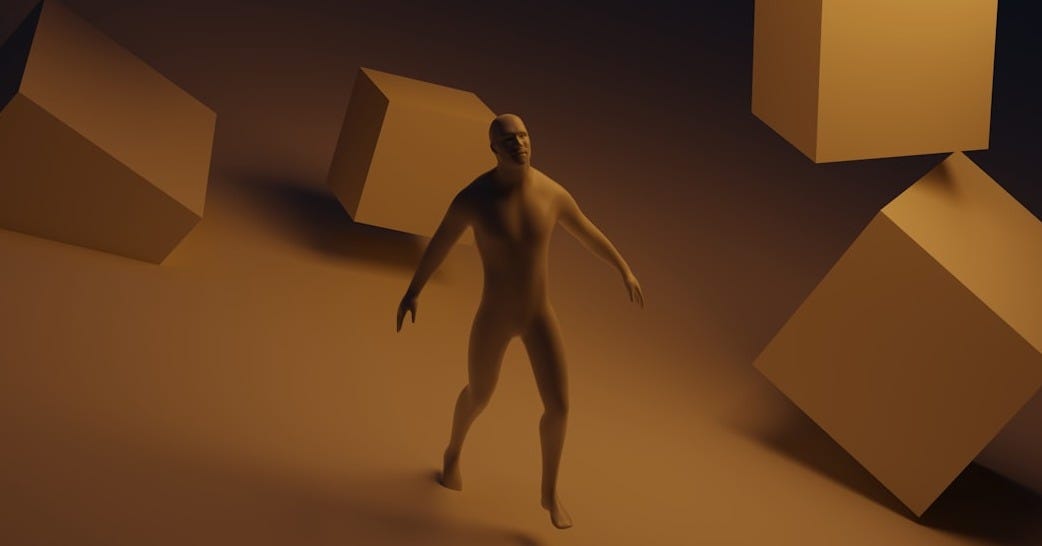
What if the problem was never that you were lazy, inconsistent, immature, distracted, “too much”, or unable to function properly?
What if modern society simply rewards a very specific kind of nervous system, personality structure, and brain wiring — and punishes everyone who falls outside of it?
Who Gets to Define a “Functional Adult”?
At some point, somewhere, someone decided that a mature adult is a person capable of sitting for eight hours a day, tolerating monotony, suppressing emotions, functioning with little rest, remaining constantly productive, and repeating the same rhythm for decades.
What is interesting is that nearly all of this contradicts the laws of nature — and therefore human nature itself, regardless of age.
From this, a strange idea emerges: the ability to adapt to the system is treated as health. If we simplify it even further, the modern world considers unnatural living to be healthy, while treating natural human responses as pathology.
A useful person — and therefore a desirable person — is someone who successfully ignores their body, burnout, emotions, and creativity. Not because they are more functional, but because they are better conditioned for survival within it.
The values celebrated within this system — punctuality, consistency, predictability, emotional restraint, efficiency — are not necessarily universal human values. They are the values of a system originally built for mass production and administration.
And somewhere on the margins of society, there are people labeled as dysfunctional simply because their humanity remains too visible.
Modern society often confuses emotional suppression with maturity.
People who work in bursts of inspiration, who need more freedom and silence, who feel deeply, who cannot tolerate repetitive tasks, whose energy is cyclical rather than linear, and who require meaning in order to function — these people are forced to fight for air in a society that constantly suffocates, suppresses, and punishes them.
Some people spend their entire lives believing there is something fundamentally wrong with them, when in reality they have simply spent too long trying to survive in environments deeply incompatible with their nature.
Conditioning begins very early in childhood, often inside the family itself — the place that is supposed to be the safest space in the world, the one place where love should exist without performance.
From there, the system continues teaching the child who they must become in order to be accepted, safe, normal, functional. Slowly, their reactions are shaped, their behavior adjusted, and eventually even their sense of self begins adapting to what the world rewards.
How many ideas have been silenced at the very gates of the system? How many colors have faded into gray? How many smiles have quietly withered away?
Perhaps it is no surprise that some people eventually abandon God altogether. How else is one supposed to make peace with a life reduced to repetition, survival, and quiet emotional suffocation? A life disconnected from meaning eventually disconnects people from the sacred as well.
The version of adulthood enforced by modern society slowly suffocates spontaneity. Over time, people lose their sense of aliveness, become disconnected from their deepest desires, and eventually no longer know who they are beyond their ability to function.
Humans do need stability — but not at the cost of their aliveness.

Puer Aeternus and the Minds Modern Life Cannot Contain
Of course, not every person who struggles within modern adulthood fits into the same psychological pattern. Carl Jung’s concept of the puer aeternus is only one psychological archetype among many.
Still, Jung recognized something deeply important: there are people whose inner nature instinctively resists excessive structure, fears limitation, and refuses to become psychologically “fixed” within rigid social roles and identities.
Such people often remain attached to potential rather than concrete reality. Within them, a deep psychological conflict unfolds. They struggle to commit to a single identity, path, or life, while carrying a longing for infinite possibility.
Their lives unfold somewhere in the liminal space between imagination and incarnation into reality.
Adulthood, on the other hand, demands the sacrifice of infinite possibilities in exchange for one concrete life. A child can become anything they wish, even changing from one day to the next, while an adult is expected to choose.
For some people, that choice feels like a small death.
I remember the moment people suddenly stopped asking me what I wanted to be when I grew up — because I had already grown up. The strange thing was that I still did not know.
Every morning, I would wake up with new ideas, new possibilities, yet with the same excitement, the same spark in my eyes that I had as a child.
The liminal space is, in many ways, a confined and almost forbidden space where we try to keep that inner spark from going out.
It is where people live suspended between potential and concrete life, between imagination and realization, between all the possible versions of themselves and one fixed reality.
They drift between possibilities, inhabiting an identity that is never fully defined — existing in transition, in uncertainty, neither fully grounded on earth nor entirely free in the sky.
The puer aeternus is not simply a playful, scattered eternal child. It carries a darker psychological dimension as well: difficulty grounding oneself in reality, avoidance of responsibility, fear of limitation, perpetual suspension between possibilities, and an inability to fully incarnate into lived life.
Do such people ever truly enter life, or do they spend years fleeing from the weight of concreteness?
They are often profoundly lonely — terrified of irreversible choices, addicted to possibility itself, and unable to fully root themselves in a tangible life.
Infinite possibility, too, can become another kind of prison.
Between Chaos and Rigidity
It was never structure itself that I resisted, but the kind of structure that demanded the slow death of everything alive within me.
Deep down, I believe that beyond all of this madness, there is still the possibility of a life where structure and freedom, responsibility and spontaneity, groundedness and imagination can coexist.
Healing is neither a return to chaos nor complete adaptation to the system. It is the gradual creation of a life capable of holding all of those parts gently.
Responsibility does not necessarily mean the death of the inner child. Perhaps it means learning how to protect it, ground it, and integrate it into reality without extinguishing its aliveness.
Whenever I lose sight of the right path, I look toward nature, because it remains our only true compass.
Our lives are conditioned by nature itself. Without it, we are incapable of sustaining life on our own — so why do we keep resisting it in the hope of surviving?
Nature, by its very essence, is neither rigid nor chaotic. A river has direction, yet it continues to move. The seasons follow a rhythm, not monotony. The heart survives through pulsation, not stillness — and so do we.
My own way of surviving, as an eternal child who still wishes to remain a functional adult, has been through gentle disciplines, meaningful routines, preserved rhythms, sustainable ways of living, and a constant balance between structure and flow.
Perhaps peace begins the moment we stop waiting for society to understand our nature before allowing ourselves to build a meaningful life.